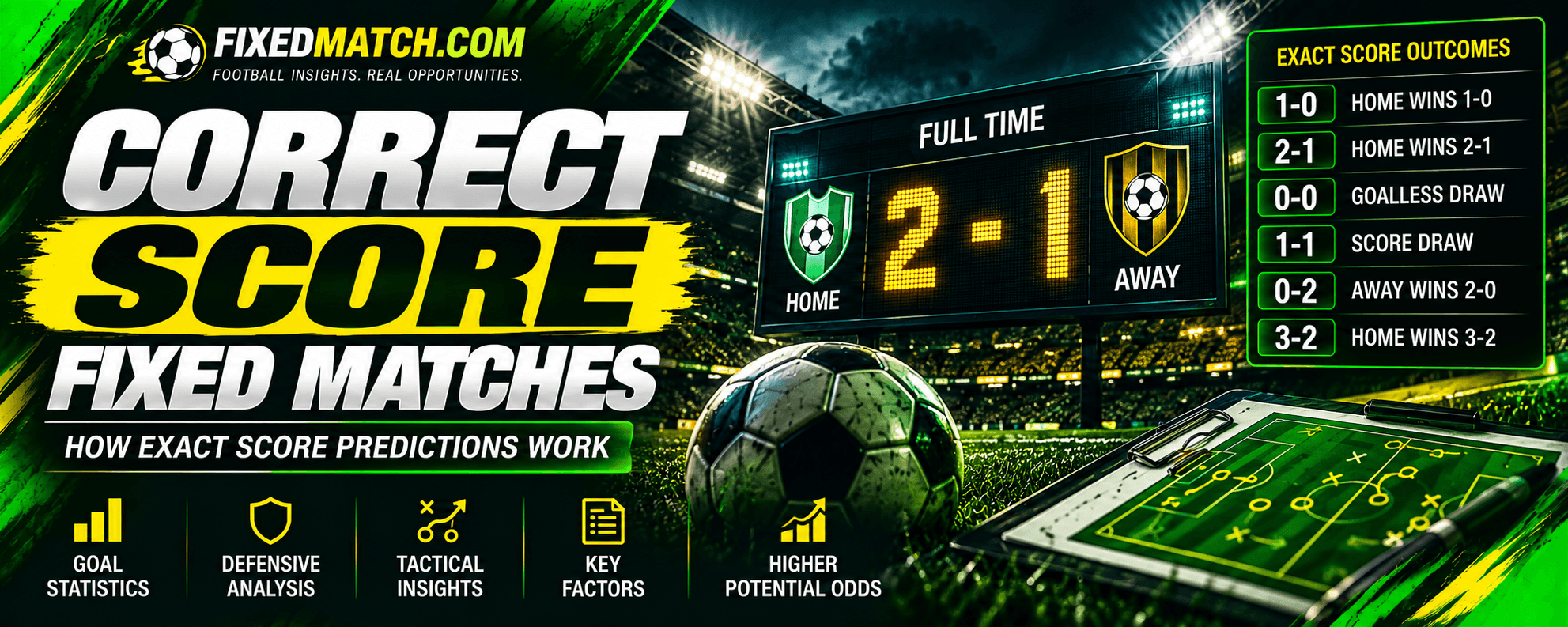
Correct Score Fixed Matches: How Exact Score Predictions Work
Sarah Martinez
A football match can finish with dozens of possible scorelines, but a correct-score prediction requires identifying just one.
Predicting that Manchester City will win is different from predicting that the final score will be exactly 2-1. The first selection allows several winning scorelines, while the second requires both teams to score the precise number of goals predicted.
That additional precision is what makes correct-score betting one of football's more demanding markets.
For anyone researching correct score fixed matches, understanding how exact-score predictions work is essential. This guide explains the market, the statistical factors that can help evaluate scorelines, the relationship between odds and probability, and why even detailed analysis cannot guarantee an exact result.
What Are Correct Score Fixed Matches?
Correct-score betting involves predicting the exact final score of a football match.
For example, a selection of 2-1 requires the home team to score exactly two goals and the away team to score exactly one.
If the match finishes 3-1, the selection loses even though the predicted winner was correct.
The expression correct score fixed matches is commonly used online when discussing exact-score selections and premium football information.
However, an important distinction remains: genuine match fixing involves deliberate manipulation of a sporting event, whereas an ordinary correct-score prediction is an estimate based on available information.
Our guide explaining what fixed matches mean covers this distinction in greater detail.
How Correct Score Betting Works
A correct-score selection contains two numbers.
The first represents the home team's final goal total.
The second represents the away team's final goal total.
For example:
| Selection | Required final score | Result |
|---|---|---|
| 1-0 | Home wins 1-0 | Exact result required |
| 2-1 | Home wins 2-1 | Exact result required |
| 0-0 | Goalless draw | Neither team scores |
| 1-1 | Score draw | Both teams score once |
| 0-2 | Away wins 2-0 | Exact result required |
| 3-2 | Home wins 3-2 | Exact result required |
These are illustrative examples, not actual match results or betting recommendations.
The important point is that predicting the correct winner is not enough.
Both goal totals must match the selection.
Why Correct Score Is Different From Match-Winner Betting
A standard 1X2 prediction contains three possible outcomes:
1 represents a home victory.
X represents a draw.
2 represents an away victory.
If you predict a home victory, the selection succeeds whether the final score is 1-0, 2-0, 2-1 or another home-winning result.
Correct-score betting is different because it identifies one specific scoreline.
Consider a fictional match between Team A and Team B.
You predict Team A to win 2-0.
If Team A wins 3-0, your general match-winner assessment was correct, but your exact-score prediction loses.
This is why football fixed matches analysis for correct-score markets requires more precise information than an ordinary match-winner prediction.
Our football-analysis guide explains how form, injuries, line-ups and odds can be evaluated together.
Start With Attacking Performance
A team's attacking record provides useful context when considering possible scorelines.
Important statistics include goals scored, chances created, shots on target and recent attacking performance.
However, raw goal totals can be misleading.
A team that scored five goals in its previous match does not automatically become likely to score five again.
The strength of the opposition, quality of the chances and availability of attacking players all matter.
A more useful approach is to examine performance across several matches rather than relying on one exceptional result.
Defensive Strength Matters Just as Much
Correct-score analysis requires evaluating both teams.
A strong attack may struggle against a well-organised defence.
A weaker attacking team may still score against an opponent that regularly concedes chances.
Useful defensive information includes:
Goals conceded.
Clean-sheet frequency.
Shots allowed.
Chances conceded.
Defensive injuries.
Goalkeeper availability.
Home and away defensive performance.
These factors help explain why different scorelines may be plausible.
They do not establish that any particular score is certain.
Expected Goals Can Provide Additional Context
Expected goals, commonly abbreviated as xG, is a statistical measure used to estimate the quality of scoring chances.
It considers characteristics of individual opportunities, such as shot location and other contextual information.
A team may win 3-0 despite creating relatively few high-quality chances.
Another may lose 1-0 despite creating several promising opportunities.
Looking only at the final score can hide those differences.
Expected goals can therefore provide additional context when assessing attacking and defensive performance.
However, xG is not a prediction of the exact final score.
It is one piece of information that can contribute to a broader analysis.
Home and Away Records
Venue can influence both attacking and defensive performance.
Some teams score more frequently at home.
Others play more conservatively away.
A team's overall season average may therefore be less useful than its record in the relevant environment.
When examining a home team's potential goal total, compare its recent home performances with the away team's defensive record.
For the away side, examine its away attacking record alongside the home team's defensive performance.
This provides a more relevant comparison than simply looking at league position.
Team News Can Change the Expected Scoreline
A missing striker can reduce attacking options.
An injured goalkeeper may affect defensive stability.
A suspended centre-back can force changes to the defensive structure.
These absences can influence the number of goals a team may score or concede.
That is why current team news should be part of any serious correct-score analysis.
Our guide to fixed matches today explains how injuries, expected line-ups and late developments can affect matchday information.
An analysis prepared several days before kick-off may need to be reconsidered when new information becomes available.
Expected Line-Ups and Tactical Changes
A team's starting eleven can significantly affect its attacking approach.
Managers sometimes rotate during busy periods.
A club may start without its usual centre-forward.
A defensive midfielder may be replaced by a more attacking player.
A manager may also choose a different formation depending on the opposition.
These changes matter because correct-score analysis depends on the attacking and defensive behaviour of both teams.
The club's reputation alone does not determine how a particular starting eleven will perform.
Tactical Matchups and Goal Expectations
Football matches are influenced by the interaction between two playing styles.
A possession-based team may struggle against an organised low block.
A team using a high defensive line may be vulnerable to fast counterattacks.
Two aggressive attacking teams may create a very different match from two sides that prefer cautious defensive structures.
Tactical analysis can help explain why certain types of matches may produce more or fewer scoring opportunities.
But unexpected events can still change the pattern.
A red card, early goal or tactical substitution may completely alter the match.
Correct Score Odds and Probability
Correct-score selections frequently offer higher odds than standard match-winner bets because they require a much more specific outcome.
Consider two hypothetical selections:
| Market | Selection | Illustrative odds |
|---|---|---|
| Match winner | Home victory | 1.80 |
| Correct score | Home wins 2-1 | 9.00 |
These figures are examples rather than actual bookmaker prices.
The correct-score selection offers a larger potential return because fewer match outcomes satisfy its conditions.
That additional return comes with additional uncertainty.
Higher odds should never be interpreted as proof that a selection is more reliable.
Understanding Implied Probability
Decimal betting odds can be converted into an implied probability using a simple formula:
For example, odds of 5.00 correspond to a raw implied probability of 20%.
Odds of 10.00 correspond to 10%.
These figures are derived from the displayed prices and do not account for the bookmaker's margin.
The distinction matters because potential payout and likelihood of success are not the same thing.
Why 1-0 and 2-1 Require Different Analysis
At first glance, both scorelines represent home victories.
But the match conditions required are different.
A 1-0 selection requires the home team to score once while preventing the opponent from scoring.
A 2-1 selection requires the home team to score twice and the away team to score once.
That means attacking and defensive expectations must be considered together.
A team that regularly keeps clean sheets may present a different statistical profile from a team that scores frequently but also concedes.
The same reasoning applies when comparing 2-0, 3-1 and other possible scorelines.
Correct Score vs HT/FT Fixed Matches
Correct-score and half-time/full-time betting are separate markets.
Correct score requires the exact final goal totals.
HT/FT requires the correct result at half-time and full-time.
For example, consider a match that finishes 2-1 after the home team leads 1-0 at half-time.
The correct-score outcome is 2-1.
The HT/FT outcome is 1/1.
If the match finishes 3-1 instead, the HT/FT outcome remains 1/1, but the 2-1 correct-score selection loses.
Our guide to HT/FT fixed matches explains all nine half-time/full-time combinations with practical examples.
Understanding both markets makes their differences much easier to recognise.
Why Previous Results Need Context
Historical information can help visitors examine how a football-information service has performed over time.
Our previous offers and completed results page provides access to earlier information.
When reviewing correct-score selections, consider whether the records include dates, advertised selections, odds and final results.
A single successful exact-score prediction provides limited evidence of long-term performance.
A broader historical record gives more context.
However, past results cannot guarantee future accuracy.
Be Careful With Guaranteed Correct Score Claims
Correct-score predictions involve substantial uncertainty.
Even when an analysis correctly anticipates which team will perform better, the exact number of goals can still differ.
An early red card may change the match.
A penalty can be missed.
VAR may overturn a goal.
An unexpected substitution can alter the attacking structure.
These events demonstrate why confident marketing language should not replace evidence.
Anyone searching for reliable fixed matches should examine transparency, historical information and the nature of the claims being made.
Our reliability guide discusses those considerations in greater detail.
Correct Score Betting and Responsible Decision-Making
A high potential return can make exact-score selections attractive.
But higher odds generally reflect a lower implied probability.
Financial risk therefore remains important.
Set limits before betting.
Avoid chasing previous losses.
Do not increase stakes simply because a selection is labelled premium or guaranteed.
Never use money needed for essential expenses.
Our responsible betting page provides additional guidance on managing betting-related risks.
How FixedMatch.com Organizes Football Information
At FixedMatch.com, visitors can explore current fixed matches information alongside educational articles covering different football markets.
Our existing guides explain match analysis, daily information, reliability and HT/FT betting.
This correct-score article adds another specialised resource by explaining the requirements of exact-score predictions and the information that can help people understand the market.
The objective is to make the different types of football information easier to distinguish and evaluate.
Correct Score Analysis Checklist
Before evaluating an exact-score selection, consider the following questions:
| Factor | What to examine |
|---|---|
| Attacking form | Recent goals and chance creation |
| Defensive performance | Goals conceded and chances allowed |
| Home and away records | Relevant venue-specific statistics |
| Team news | Injuries and suspensions |
| Expected line-ups | Likely attacking and defensive personnel |
| Tactical matchup | How the two playing styles interact |
| Fixture schedule | Rest, travel and possible rotation |
| Odds | Market price and implied probability |
| Previous results | Historical information and transparency |
No single factor guarantees a particular scoreline.
The purpose of the checklist is to provide a more complete understanding of the match.
Final Thoughts
Correct-score betting requires predicting the exact number of goals scored by both teams.
That makes it different from ordinary match-winner and HT/FT selections.
Attacking performance, defensive strength, home and away statistics, team news, tactical matchups and odds can all provide useful context.
However, detailed analysis cannot remove the uncertainty involved in predicting an exact score.
For anyone researching correct score fixed matches, understanding the market and evaluating the available evidence is more useful than relying on confident promises or unusually high advertised returns.
A strong understanding of football information begins with recognising both what the available data can explain and what it cannot guarantee.