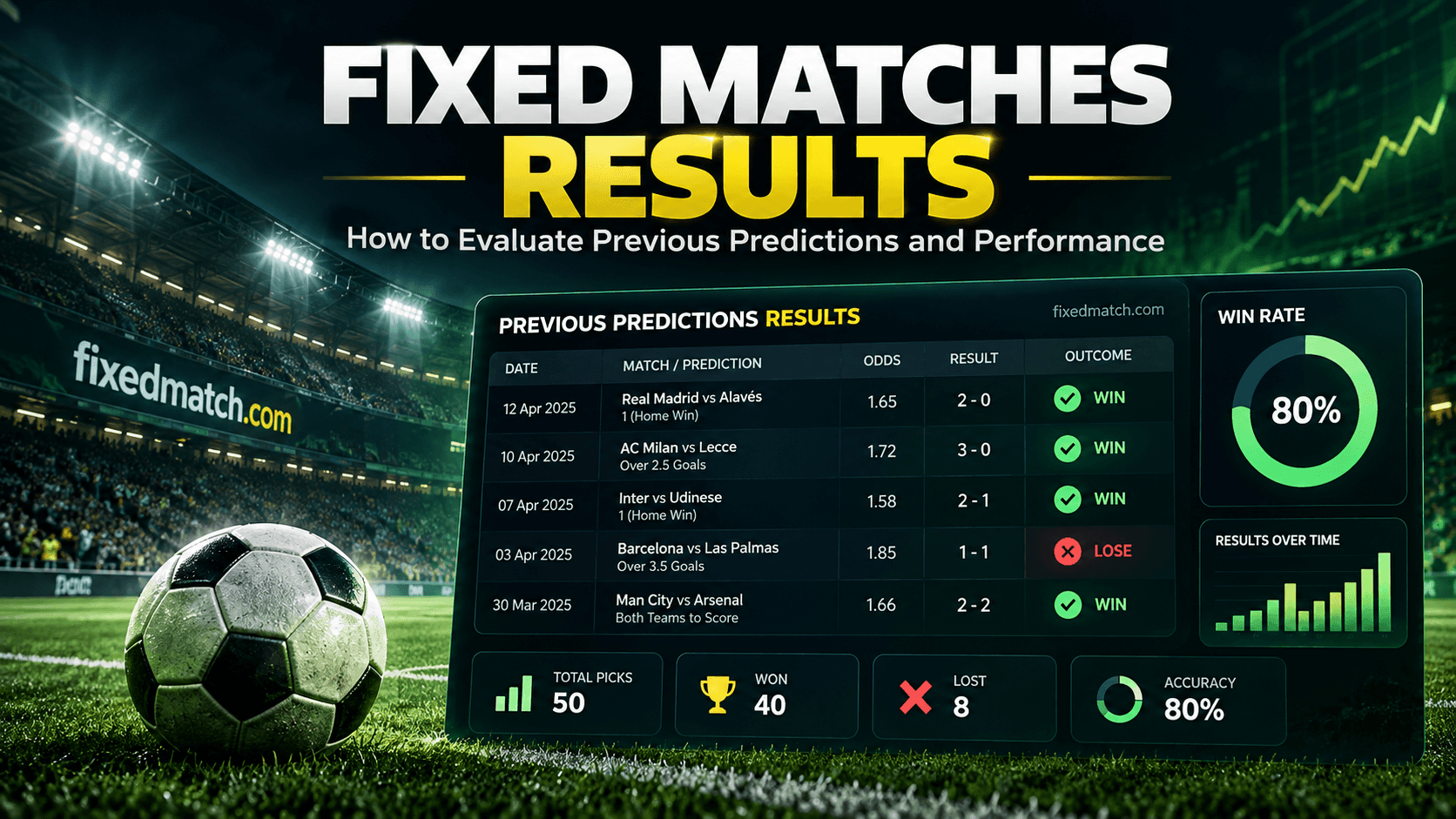
Fixed Matches Results: How to Evaluate Previous Predictions and Performance
David Thompson
A winning football prediction can look impressive, especially when it involves an exact score or high odds. But one successful selection tells only a small part of the story.
To understand how a football-information service has performed, visitors need more than an isolated screenshot. They need dates, original selections, advertised odds, final results and enough historical information to recognise patterns over time.
This is why reviewing fixed matches results can be an important part of evaluating football information.
A transparent results history helps visitors distinguish between documented past performance and promotional claims. It also provides context that individual winning tickets cannot offer.
This guide explains how to read previous football results, what information a useful archive should contain and why historical success cannot guarantee future outcomes.
What Are Fixed Matches Results?
The expression fixed matches results is commonly used online when people search for previous football selections and their completed outcomes.
Some websites publish individual results. Others maintain larger archives containing dates, match information, predicted markets and final scores.
However, terminology matters.
In its strict sporting meaning, match fixing involves deliberate manipulation of a sporting event. A successful football prediction does not demonstrate that a match was manipulated.
Our guide explaining what fixed matches mean covers this distinction in greater detail.
When reviewing historical football information, the main objective should be to establish what was predicted, when it was published and what actually happened.
Why Previous Results Matter
Historical information can help visitors understand how a service has performed across multiple selections.
For example, a website might display an impressive winning ticket with odds of 20.00.
That result may attract attention, but it does not explain how many other selections were published during the same period.
A more complete historical record allows visitors to examine successful and unsuccessful predictions together.
This makes it easier to assess consistency rather than relying on a single highlighted outcome.
Our previous offers and completed results page provides a place for visitors to review historical information.
What Should a Football Results Archive Include?
A useful results archive should provide enough information to understand each entry.
Ideally, that includes:
Match date.
Teams involved.
Original selection.
Betting market.
Advertised odds.
Final result.
Whether the selection succeeded.
Original publication time, where available.
These details make historical information easier to evaluate.
The publication time is particularly useful because it helps establish whether the selection was available before the match began.
Example of a Transparent Results Table
Consider the following fictional historical record.
| Match | Prediction | Odds | Final result | Outcome |
|---|---|---|---|---|
| Team A vs Team B | Home win | 1.80 | 2-0 | Won |
| Team C vs Team D | Over 2.5 goals | 1.95 | 1-1 | Lost |
| Team E vs Team F | Correct score 2-1 | 8.50 | 2-1 | Won |
| Team G vs Team H | HT/FT X/1 | 4.20 | HT 0-0, FT 1-1 | Lost |
| Team I vs Team J | Away win | 2.10 | 0-2 | Won |
These examples are fictional and do not represent FixedMatch.com results.
This table allows visitors to see both winning and losing selections.
It also makes the different betting markets easier to distinguish.
That provides substantially more context than displaying only the three successful outcomes.
Why Winning Screenshots Are Not Enough
A screenshot can show a successful ticket, but important information may be missing.
For example, it may not establish whether the prediction was published before kick-off.
It may also omit unsuccessful selections from the same period.
A screenshot showing a successful correct-score prediction does not demonstrate that a service consistently predicts exact results.
This is why individual images should be considered alongside a broader historical record.
A useful archive should make the original information and completed outcome reasonably easy to compare.
Understanding Win Rate
Win rate measures the percentage of selections that succeeded.
The basic calculation is:
Imagine a service publishes 20 settled selections.
If 12 succeed, its win rate is 60%.
But win rate alone does not describe profitability.
The odds attached to each selection also matter.
A service winning 60% of selections at very low odds can produce a different financial result from one winning 40% at substantially higher odds.
This is why previous results should be examined using more than one metric.
Why Odds Matter When Reviewing Results
Odds determine the potential return from a successful selection.
Consider two hypothetical records:
| Record | Selections | Winners | Average winning odds |
|---|---|---|---|
| A | 10 | 8 | 1.20 |
| B | 10 | 5 | 2.50 |
Record A has a higher win rate.
Record B has higher average winning odds.
Neither record can be fully evaluated using win rate alone.
The stake size, prices obtained and complete sequence of results are needed to understand financial performance.
This illustrates why the phrase best fixed matches should not be judged using one isolated statistic.
Our guide to best fixed matches explores other factors that can help people evaluate football selections.
Correct Score Results Require Additional Context
Correct-score betting requires predicting the exact final result.
A selection of 2-1 loses if the match finishes 3-1, even though the predicted winner was correct.
This makes exact-score records different from ordinary match-winner records.
When reviewing correct-score results, check whether the originally advertised scoreline matches the completed result.
Our guide to correct score fixed matches explains how exact-score markets work and why they require additional precision.
A successful exact-score prediction can be noteworthy, but one result cannot establish the accuracy of future predictions.
Understanding HT/FT Results
Half-time/full-time betting requires predicting two outcomes within the same match.
For example, X/1 means the match must be level at half-time before the home team wins at full-time.
If the home team leads at half-time and eventually wins, the X/1 selection loses.
That means an HT/FT results archive should ideally show both the half-time and final scores.
Our HT/FT fixed matches guide explains all nine possible combinations.
This information helps visitors verify whether a published HT/FT selection actually succeeded.
Why Publication Dates Matter
Dates are another important part of a credible historical record.
Without them, visitors may struggle to determine when a prediction was made.
A completed result should not be presented as though it were a newly available future selection.
Clear dates also help visitors understand the period covered by a historical record.
For example, results from one week should not be presented as evidence of performance across several years.
The time period must be clear.
Be Careful With Selective Results
A service may publish ten predictions but display only the most successful examples.
That creates an incomplete picture.
It can make the historical performance appear stronger than the full record would suggest.
When reviewing reliable fixed matches, transparency across successful and unsuccessful outcomes is therefore important.
Our reliability guide explains why consistency and historical information are more useful than confident marketing language alone.
A complete record should allow visitors to understand the unsuccessful selections as well as the successful ones.
Can Previous Results Predict Future Performance?
Historical performance can provide useful context, but it cannot guarantee future results.
Football circumstances change continuously.
Players become injured.
Managers change tactics.
Teams improve or decline.
Transfers alter squad strength.
Competition schedules affect preparation.
Even a service with a documented history must evaluate each new fixture according to its current circumstances.
That is why previous results should be considered alongside current team news and match analysis.
Current Information Still Matters
A successful prediction from several months ago may demonstrate what happened during that particular fixture.
It does not necessarily provide useful information about today's match.
Current injuries, expected line-ups, recent form and tactical changes may be more relevant.
Our guide to fixed matches today explains how matchday developments can affect football information.
Historical performance provides context.
Current information helps explain the circumstances of the next fixture.
Both have different purposes.
Comparing Different Football Information Sources
When comparing sources, consider whether each one maintains a consistent record.
Look at the availability of old selections.
Check whether dates and odds are displayed.
Review whether losses remain visible.
Consider whether the website clearly distinguishes completed results from upcoming selections.
Our guide to soccer fixed matches explains how different football-information sources can be compared using transparency, current information and historical records.
The objective is to make comparisons using available evidence rather than promotional claims.
Responsible Betting and Historical Performance
A successful historical record does not remove betting risk.
A winning streak can create the impression that future selections are more certain than they actually are.
That can encourage excessive confidence or larger financial commitments.
A responsible approach involves setting limits, avoiding attempts to recover previous losses and recognising that future outcomes remain uncertain.
No historical record guarantees the next result.
How FixedMatch.com Organizes Football Results
At FixedMatch.com, visitors can explore current fixed matches information alongside historical records and educational football content.
The purpose of separating these resources is to make it easier to distinguish between upcoming selections and completed outcomes.
Supporting articles explain different betting markets, football analysis, historical performance and the limitations of prediction information.
Visitors can use those resources to better understand what a past result demonstrates and what it cannot establish.
Final Thoughts
Reviewing fixed matches results involves more than looking at successful betting tickets.
A useful historical record should contain clear dates, original selections, relevant odds and completed results.
Win rate can provide information, but it should not be considered independently of odds and other relevant factors.
Correct-score and HT/FT markets also require their own verification because their conditions differ from ordinary match-winner selections.
Most importantly, previous success does not guarantee future outcomes.
Transparent historical information helps visitors understand past performance. Current football analysis remains necessary when evaluating future fixtures.