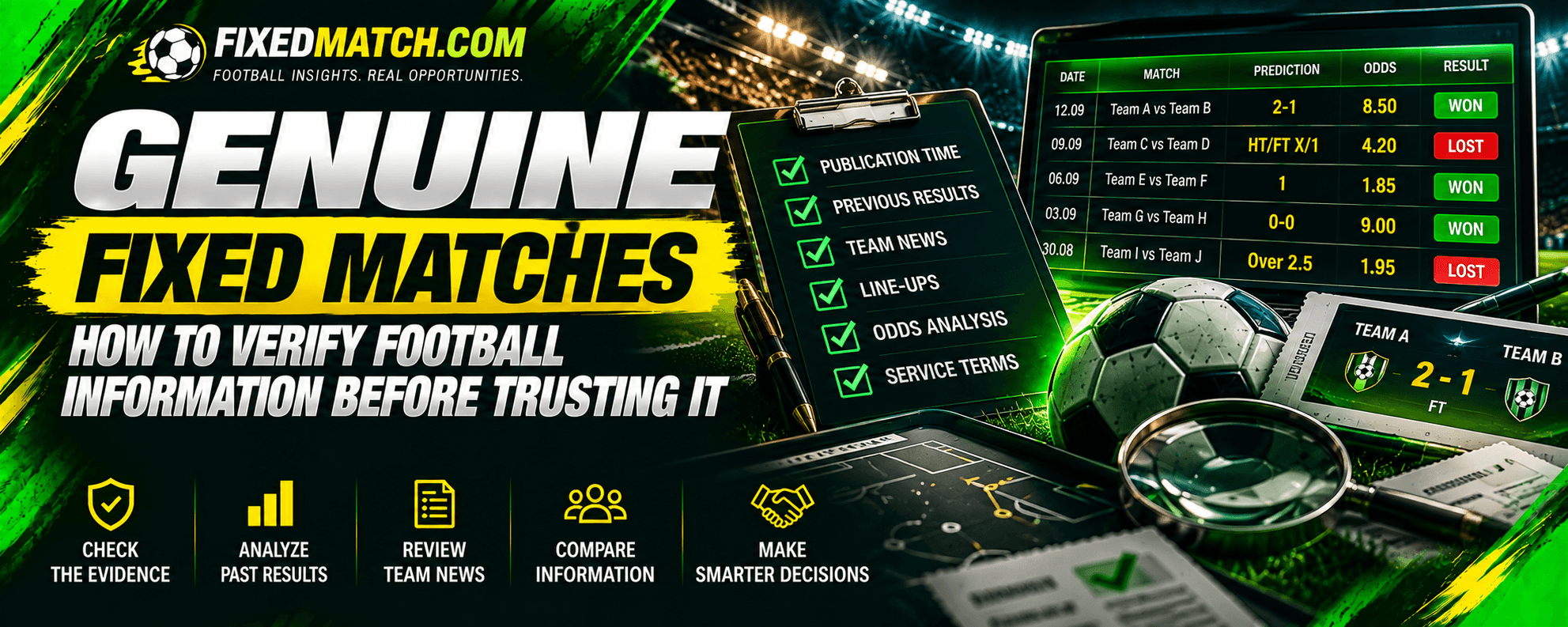
Genuine Fixed Matches: How to Verify Football Information Before Trusting It
Carlos Ramirez
Anyone can describe football information as genuine. Proving that description is much harder.
A website can use confident language, show winning screenshots and advertise impressive odds, but none of those things automatically demonstrate that the information deserves trust.
For people researching genuine fixed matches, the better approach is to examine the evidence behind the claim.
When was the selection published? Can previous results still be reviewed? Are unsuccessful predictions visible? Does the current team information support the selection? Are the terms clear before payment?
Those questions tell you far more than a label such as “real,” “genuine” or “guaranteed.”
This guide explains how to verify football information more carefully before relying on it.
What Does “Genuine Fixed Matches” Mean?
The phrase genuine fixed matches is widely used online, but different websites may use it in different ways.
In the strict sporting sense, a fixed match involves deliberate manipulation of a competition.
Online, however, the expression is also frequently used to describe premium football selections or predictions that a provider believes are especially strong.
Those meanings should not be confused.
Understanding what fixed matches mean is therefore the first step before evaluating any claim of authenticity.
A successful prediction does not prove that a sporting event was manipulated.
Likewise, calling something genuine does not make it genuine.
Evidence matters more than terminology.
Start With the Publication Time
One of the simplest checks is also one of the most useful.
Was the prediction visible before the match?
A result displayed only after the final whistle provides limited evidence.
For example, imagine a website publishes:
Correct Score: Team A 2–1 Team B
If the page, post or message clearly existed before kick-off, that provides considerably more context than a screenshot uploaded after the match finished.
The timestamp alone does not prove future accuracy.
But it helps verify that the selection was genuinely made before the outcome was known.
Previous Results Should Remain Available
A transparent football service should ideally maintain some history.
Visitors should be able to compare previous selections with completed outcomes rather than seeing only the latest winning example.
That is why previous offers and completed results are useful when evaluating historical performance.
A stronger record may contain:
- publication dates
- teams
- original selections
- betting markets
- advertised odds
- final results
- winning and losing outcomes
A single result is easy to highlight.
A longer history is much harder to judge selectively.
Losing Predictions Matter Too
This is an important point.
A results page showing only wins does not provide the same information as a record containing both wins and losses.
Suppose a service published ten predictions.
Four won.
Six lost.
If visitors are shown only the four winners, they receive a distorted view of the actual performance.
Transparency requires context.
That does not mean every service needs a sophisticated statistics dashboard.
It simply means historical information is more useful when unsuccessful selections do not disappear.
Screenshots Should Be Treated as Supporting Evidence
Winning-ticket screenshots can be useful.
They should not be the entire case.
An image may show:
- a correct score
- high odds
- a large payout
- the bookmaker interface
But the screenshot may not establish when the selection was originally shared.
It also does not show how many unsuccessful tickets existed during the same period.
For genuine fixed matches, screenshots are stronger when they support an already documented prediction rather than acting as the only evidence.
Current Match Information Should Support the Claim
Historical verification is only one part of the process.
The next fixture still needs to make sense.
Suppose a selection heavily favours the home team.
Before trusting it, check whether important developments have occurred.
A striker may be injured.
The goalkeeper may be suspended.
The manager may rotate before a European fixture.
An important midfielder may have been ruled out after the original analysis was prepared.
These developments are why fixed matches today should be evaluated using current information rather than relying entirely on older statistics.
Expected Line-Ups Can Reveal Problems
A football prediction might initially look convincing.
Then the expected line-up appears.
Five regular starters are missing.
That changes the context.
A club name does not guarantee that the strongest possible team will start.
Expected and confirmed line-ups can therefore help verify whether the reasoning behind a selection still makes sense.
This becomes especially important during periods of fixture congestion.
Compare the Claim With Team Form
Recent results can support or weaken a prediction.
But form needs context.
Five consecutive wins against weaker opponents do not necessarily prove that a team will dominate a stronger opponent.
Likewise, three defeats against title contenders may not mean a team is performing badly.
Useful form analysis considers:
- opponent quality
- home and away performance
- goals scored
- goals conceded
- chance creation
- defensive mistakes
A genuine-looking selection should still make sense once these factors are considered.
Home and Away Performance Can Tell Different Stories
Some clubs are significantly stronger at home.
Others are more dangerous away because they play effectively on the counterattack.
That means overall form can sometimes hide meaningful differences.
Imagine a team with the following record:
| Situation | Matches | Wins |
|---|---|---|
| Home | 10 | 8 |
| Away | 10 | 3 |
Looking only at 11 wins from 20 matches hides the difference between its home and away performance.
The relevant environment should always be considered.
Verify the Betting Market
Not every football selection requires the same level of precision.
A home-win prediction is different from:
- correct score
- HT/FT
- BTTS
- over/under goals
- accumulator selections
For example, correct score fixed matches require the exact final score.
A prediction of 2–1 loses if the match finishes 3–1.
HT/FT is different again because both the half-time and full-time results must be correct.
Understanding the market makes it easier to judge the strength of the claim.
Odds Can Provide Useful Context
Odds reflect how the betting market prices an outcome.
They are not proof that a selection is genuine.
If a correct-score prediction carries very high odds, that generally reflects the difficulty of predicting such a precise outcome.
A large potential payout may look attractive.
It also normally comes with greater uncertainty.
This is why odds should be considered alongside the reasoning rather than used as evidence on their own.
Genuine Does Not Mean Guaranteed
This distinction is especially important.
Even strong football information can lose.
Unexpected events happen:
- red cards
- missed penalties
- injuries
- goalkeeper errors
- VAR decisions
- tactical substitutions
- deflections
No ordinary prediction process can eliminate these possibilities.
A service can provide analysis.
It can provide historical records.
It can provide current information.
None of those things make a future football result certain.
Compare More Than One Source
Another useful verification method is comparison.
If several sources discuss the same match, compare their reasoning rather than simply counting how many agree.
Our soccer fixed matches article explains why copied predictions can create the impression of independent confirmation even when several websites are repeating the same original claim.
Look for differences in:
- team information
- statistics
- reasoning
- market selection
- timing
Independent analysis is more meaningful than repetition.
Check Whether the Information Changes After Publication
Predictions should not be quietly rewritten after the event.
If possible, compare the original selection with the completed result.
Changing a 2–1 prediction into 1–0 after the final whistle would obviously destroy the usefulness of the historical record.
Stable publication history makes verification easier.
Examine the Service Terms
Authenticity is not only about the football selection.
Customers should also understand the service.
Before paying, check:
- what is included
- the price
- delivery method
- delivery timing
- refund conditions
- replacement conditions
- subscription duration
This is especially relevant when deciding whether to buy fixed matches or another paid football-information product.
Clear terms make the service easier to evaluate before money changes hands.
Premium Pricing Does Not Prove Authenticity
A high price can create the impression that information must be valuable.
That assumption is unreliable.
Premium football services should justify their pricing through better service, stronger transparency or more detailed information.
Our premium fixed matches article explains what customers should reasonably expect from a premium football service.
The price itself proves nothing about the outcome.
Historical Results Need Enough Data
Suppose one provider has:
- 3 displayed selections
- 3 wins
Another has:
- 100 displayed selections
- 68 wins
The first provider technically shows a 100% historical win rate.
But three selections provide much less information than 100.
This is why sample size matters.
A very short record should not be treated as equal to a longer documented history.
Look for Consistency Over Time
Consistency can be more useful than a short winning streak.
Football results naturally vary.
A service should therefore be evaluated across a meaningful period rather than only during its strongest week.
That is also why fixed matches results should be reviewed as a sequence rather than as isolated screenshots.
Dates and historical continuity provide valuable context.
Watch for Excessive Pressure
A genuine service should not need unrealistic urgency to make its information credible.
Be cautious with messages such as:
“Pay in five minutes.”
“Last guaranteed ticket.”
“One place remaining.”
“Impossible to lose.”
Some football information genuinely becomes time-sensitive near kick-off.
But urgency should not prevent customers from understanding what they are buying.
Responsible Decisions Still Matter
Verification does not remove betting risk.
Even after reviewing previous results, current team news and the available evidence, the future remains uncertain.
Set limits.
Avoid chasing losses.
Do not borrow money to place bets.
Never use essential household funds.
A verified historical prediction does not make the next prediction guaranteed.
How FixedMatch.com Organizes Football Information
FixedMatch.com separates current fixed matches information from educational articles and historical results.
Visitors can review different football markets, previous information and supporting guides rather than relying on one claim alone.
That structure makes it easier to understand:
what is currently available,
what happened previously,
and how different football markets work.
Verification becomes more useful when information can be compared across those areas.
Genuine Fixed Matches Verification Checklist
Before trusting football information, check:
| Check | Question |
|---|---|
| Publication | Was the prediction available before kick-off? |
| History | Can previous selections still be reviewed? |
| Losses | Are unsuccessful results visible? |
| Team news | Is the information current? |
| Line-ups | Are important absences considered? |
| Form | Does recent performance support the claim? |
| Market | Do you understand what must happen for the selection to win? |
| Odds | Do the odds reflect significant uncertainty? |
| Terms | Is the service clearly explained? |
| Pressure | Are you being rushed unnecessarily? |
No single item proves that future information will succeed.
Together, however, these checks provide a much better basis for evaluation.
Final Thoughts
The word genuine is easy to write.
Evidence is harder to provide.
When evaluating genuine fixed matches, look beyond the headline.
Check when the information was published.
Review historical results.
Look for losing selections as well as winners.
Compare the prediction with current team news.
Understand the betting market.
Read the terms.
Question guarantees.
The strongest evidence is information that can be examined before and after the match without changing its story.
That still cannot guarantee the next result.
But it provides far more useful context than confidence alone.