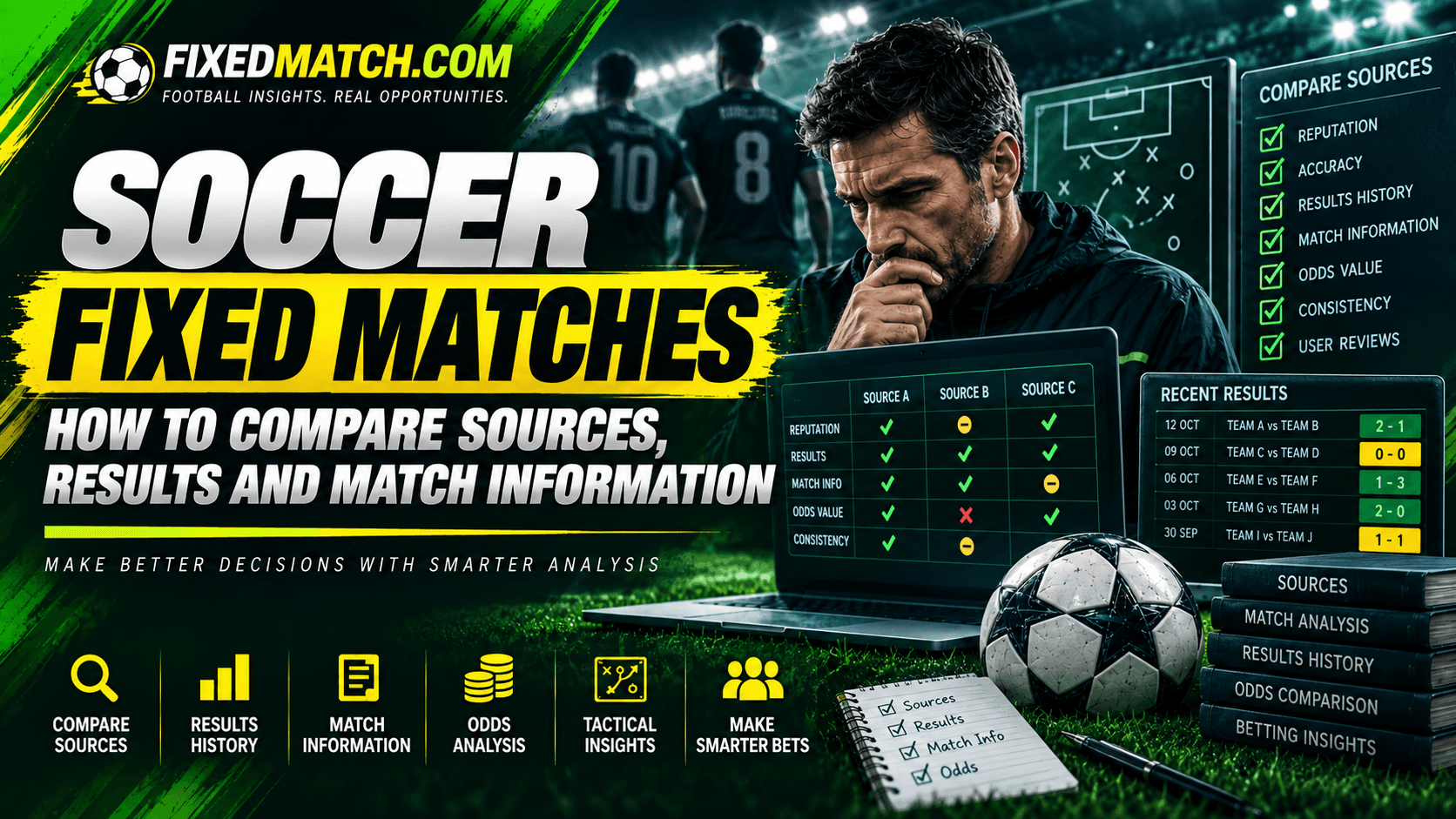
Soccer Fixed Matches: How to Compare Sources, Results and Match Information
Anna Petrova
People searching for soccer fixed matches often come across many websites, social-media pages and private groups claiming to provide reliable football information.
The challenge is not finding claims.
The challenge is deciding which information is actually worth considering.
Some sources focus on statistics. Others emphasize previous results, premium selections or high-confidence predictions. Some display large winning tickets without explaining how the selections were made.
That makes comparison difficult.
A better approach is to judge each source by the quality of its information, transparency, consistency and how clearly it explains what is being offered.
This guide explains how to compare soccer fixed matches sources, evaluate previous results, review current match information and avoid relying on marketing language alone.
What Does “Soccer Fixed Matches” Mean?
The phrase soccer fixed matches is commonly used by people searching for football information in countries where the sport is usually called soccer.
In practice, the phrase often overlaps with searches for:
- football fixed matches
- reliable fixed matches
- best fixed matches
- fixed matches today
- football predictions
- premium football information
But the terminology can be confusing.
In the strict sporting sense, a fixed match involves deliberate manipulation.
A football prediction is different.
It is an estimate based on available information.
Our guide explaining what fixed matches mean covers this distinction in more detail.
When comparing soccer fixed-match sources, the most important thing is not the label.
It is the evidence behind the information.
Start by Comparing Transparency
Transparency should be one of the first things you examine.
A useful source should make it reasonably clear what it provides.
You should be able to understand:
- what type of selections are offered
- how information is delivered
- when it is delivered
- whether previous results are visible
- whether terms are explained
- what happens if a selection loses
A source that hides basic information behind aggressive sales messages is harder to evaluate.
The clearer the service is, the easier it becomes to compare with alternatives.
Previous Results Matter
Past performance does not guarantee future results.
But previous information still provides useful context.
This is why previous offers and completed results can be valuable.
A single winning screenshot tells you very little.
A longer record allows you to examine consistency over time.
Look at whether previous selections remain visible.
Check whether unsuccessful results are also shown.
Ask whether the presentation changes after losses.
Transparency is much more useful than selective highlights.
Winning Screenshots Are Not Enough
Winning tickets can look impressive.
They are also easy to use as marketing material.
A screenshot may show a large payout, high odds or a successful correct-score selection.
But it does not show:
- how many other selections failed
- whether the ticket was published before the match
- whether the odds were available to customers
- whether the image was edited
- whether similar results were consistently achieved
This is why screenshots should never be the main reason to trust a source.
A historical record is stronger evidence than one dramatic win.
Compare Current Match Information
Good soccer analysis should reflect current information.
Football changes quickly.
A team may lose a key player to injury.
A manager may rotate.
A suspension may affect the starting eleven.
A new signing may make a debut.
That means analysis prepared several days earlier may no longer be as useful.
Our guide to fixed matches today explains why current team news, expected line-ups and last-minute changes matter so much.
If two sources offer different views on the same match, check which one is using the most recent information.
Freshness matters.
Team News Should Be Specific
Some websites simply say a team is “strong” or “in good form.”
That is not enough.
More useful analysis explains why.
Which players are available?
Who is missing?
Does the absence affect defence, midfield or attack?
Is the team using its normal starting eleven?
Specific information is easier to evaluate than vague confidence.
Line-Ups Can Change a Prediction
Expected line-ups are one of the most important parts of pre-match analysis.
Imagine a top team is expected to win comfortably.
Then the manager rests five regular starters.
The original prediction may no longer be as strong.
This is why football fixed matches analysis should always consider line-ups and squad availability.
Our article on football fixed matches explains how form, injuries and odds can be combined more carefully.
Compare Home and Away Form
Overall form can be misleading.
Some teams perform much better at home.
Others are more effective away.
A team may have won four of its last five matches, but if all four wins came at home and the next fixture is away, that matters.
When comparing different sources, check whether they separate home and away data.
The more specific the context, the more useful the analysis becomes.
Look at the Strength of Opposition
A strong record against weak opponents is not the same as strong performance against top teams.
This is another area where different sources can vary.
One source may highlight five consecutive wins.
Another may point out that all five came against teams near the bottom of the table.
The second source provides more context.
That does not automatically make its prediction correct.
But it makes the reasoning more useful.
Odds Can Help You Compare Opinions
Betting odds provide useful context because they reflect market expectations.
If one team is priced as a heavy favourite, the market clearly sees it as more likely to win.
But odds should not be treated as proof.
They move for many reasons.
New information.
Public betting activity.
Injuries.
Confirmed line-ups.
Market adjustments.
The best use of odds is as another piece of information.
Not as the final answer.
Compare Odds With the Prediction
A prediction should make sense relative to the price.
If a source claims a selection is extremely strong, check whether the odds support that view.
Very high odds generally indicate greater uncertainty.
Very low odds offer smaller potential returns.
This does not mean one is automatically better.
It means risk and reward should be considered together.
Reliable Fixed Matches Should Show Consistency
The phrase reliable fixed matches sounds attractive because bettors naturally want information they can trust.
But reliability should be judged over time.
Our article on reliable fixed matches explains why consistency matters more than one result.
Look for patterns.
Does the source publish regularly?
Do previous selections remain available?
Are results updated honestly?
Does the information style remain consistent?
Those details help you compare sources more effectively.
Best Fixed Matches Should Be Supported by Evidence
Some websites label selections as the best fixed matches.
That may be useful as a category.
But the label itself does not prove quality.
Our guide to best fixed matches explains that stronger selections are usually supported by several factors.
Recent form.
Team news.
Tactical matchup.
Home or away advantage.
Reasonable odds.
When several pieces of evidence point in the same direction, the analysis becomes stronger.
Avoid Copy-Paste Sources
One common problem is copied content.
Several websites may publish almost identical predictions.
That can make the information appear more widely supported than it really is.
But those sources may all be repeating the same original claim.
This is why originality matters.
Look for sources that explain their reasoning in their own way.
Repeated wording can be a warning sign that the information has simply been copied.
Social Media Claims Need Extra Caution
Social media moves fast.
Claims can spread quickly.
A prediction may be reposted hundreds of times within minutes.
That does not make it reliable.
Accounts can disappear.
Old posts can be deleted.
Screenshots can be difficult to verify.
That is why website-based historical information is often easier to evaluate over time.
Social media can provide useful updates.
But it should not be your only source.
Compare the Type of Market
Different sources may focus on different betting markets.
Some specialise in match winners.
Others focus on:
- correct score
- HT/FT
- both teams to score
- over/under goals
- accumulators
- combination tickets
Each market requires different analysis.
A correct-score prediction needs much more precision than a simple match-winner selection.
This means you should compare sources based on the market they actually specialize in.
Correct Score Requires More Evidence
Correct-score predictions can look impressive because the odds are often high.
But they are also difficult.
Predicting the exact score requires both teams’ goal totals to be correct.
A match expected to finish 2-0 could easily end 1-0 or 2-1.
That small difference is enough to lose the prediction.
This is why correct-score claims deserve extra scrutiny.
HT/FT Analysis Needs First-Half Data
Half-time/full-time selections are different.
A team may start slowly but finish strongly.
Another may score early and then protect the lead.
This means first-half performance matters.
If a source publishes HT/FT selections, check whether its analysis actually considers first-half trends.
Using only full-match statistics may not be enough.
Football Betting Predictions Should Be Explained
Good football betting predictions should not just tell you what to pick.
They should help explain why the selection makes sense.
Our football prediction guide looks more closely at how form, statistics, team news and match context can be combined.
When comparing sources, the one that gives you more useful reasoning is usually easier to evaluate.
Be Careful With Guaranteed Language
Absolute guarantees should always be treated carefully.
Football is unpredictable.
A red card can change a match.
A penalty can be missed.
VAR can overturn a goal.
A goalkeeper can make a major error.
No ordinary football prediction can remove those risks.
This is why words such as “guaranteed” or “impossible to lose” should not replace evidence.
Avoid Pressure Tactics
Another warning sign is urgency.
Messages like:
“Buy now.”
“Last chance.”
“Only one ticket left.”
“Guaranteed match in 10 minutes.”
can encourage impulsive decisions.
Good information should still make sense without pressure.
Take time to understand what is being offered.
Missing one match is better than making a rushed decision.
Price Does Not Equal Quality
A more expensive service is not automatically more reliable.
A lower-priced service is not automatically worse.
The price should be judged relative to what is provided.
Ask:
What information do I receive?
How often?
How is it delivered?
Can I review previous results?
What are the terms?
These questions matter more than the price alone.
Responsible Betting Still Matters
Even if you believe one source is stronger than another, financial risk remains.
This is where responsible betting matters.
Set limits.
Avoid chasing losses.
Do not increase stakes emotionally.
Never use money needed for essential expenses.
And remember that strong information does not guarantee an outcome.
How FixedMatch.com Organizes Soccer Information
At FixedMatch.com, visitors can review current fixed matches information alongside supporting educational content.
The main page provides access to current football information.
Supporting blog articles explain topics such as:
- soccer fixed matches
- football fixed matches
- reliable fixed matches
- best fixed matches
- fixed matches today
- football predictions
This structure makes it easier to compare current selections with broader football analysis.
A Simple Source Comparison Checklist
Before trusting any soccer fixed-match source, ask:
Does it explain what it offers?
Can I see previous results?
Are losing selections visible?
Is the information current?
Does it mention team news?
Does it consider line-ups?
Are odds explained?
Does the reasoning make sense?
Is the content original?
Are the terms clear?
Is there excessive pressure?
Does the source make unrealistic guarantees?
The more clearly you can answer these questions, the easier it becomes to compare different sources.
Final Thoughts
Finding useful soccer fixed matches information is not about choosing the website with the strongest headline.
It is about comparing evidence.
Look at transparency.
Review previous results.
Check whether information is current.
Compare team news.
Examine expected line-ups.
Consider the market being predicted.
Check whether the odds make sense.
And avoid relying on screenshots, pressure or guarantees alone.
Whether you are researching football fixed matches, reliable fixed matches, best fixed matches or fixed matches today, the same principle applies:
Good information should become more convincing when you examine it closely.
Not less.