Lionel Messi’s Last Dance With Argentina: Goodbye to the Greatest of All Time
Carlos Ramirez
There are footballers who define seasons.
There are footballers who define generations.
And then there is Lionel Messi.
For more than two decades, Messi has been part of the emotional landscape of football itself: the left foot, the impossible dribbles, the passes nobody else saw, the goals that looked rehearsed by imagination rather than reality, the No. 10 shirt, the pressure, the heartbreak, the trophies, the redemption.
Now there is one final Argentina match left.
On October 6, 2026, Lionel Messi will make his farewell appearance for Argentina against Benin at the Estadio Monumental in Buenos Aires, the stadium where generations of Argentine supporters have watched their national team write history. FIFA has confirmed that the 39-year-old will make his final appearance after announcing his international retirement at the end of August.
It will be his 208th appearance if he plays, adding one last chapter to an international career that currently stands at 207 caps and 125 goals.
But reducing Messi to numbers has always felt inadequate.
This night is not really about 208 appearances.
It is about saying goodbye to the player who made football look different.
Before the Trophies, There Was the Football
Messi did not become extraordinary when he lifted a trophy.
He was extraordinary long before that.
The reason people fell in love with watching him was not because a medal told them to.
It was the football.
The first touch.
The balance.
The acceleration.
The way he could receive the ball surrounded by defenders and somehow emerge on the other side with it still attached to his left foot.
The way he could begin a move near the halfway line, eliminate two or three opponents, play the final pass and still appear inside the box seconds later.
For most players, dribbling, scoring and creating are separate specialties.
Messi turned them into one football language.
He could be the playmaker and the finisher in the same movement.
He could control the tempo of a match and then suddenly destroy it.
He could spend several minutes appearing almost detached from the game before finding one passing lane nobody else had noticed.
That ability is what made him different.
The trophies confirmed the greatness.
They did not create it.
He Made the Impossible Feel Normal
Perhaps Messi’s greatest achievement is something that cannot be measured.
He changed what supporters considered normal.
A player dribbling through four defenders should have been extraordinary.
With Messi, it happened often enough that people began expecting it.
A free kick into the top corner from 25 metres should have been an event.
Eventually, Messi stepping over a dead ball created the expectation that something special was about to happen.
A defence could spend an entire week preparing for him.
Everyone could know exactly what he wanted to do.
He would still do it.
That is the strange thing about greatness.
At some point, the extraordinary becomes familiar.
And because Messi made brilliance so familiar, people occasionally forgot just how difficult the things he was doing really were.
The Numbers Are Almost Absurd
Even though numbers cannot fully explain Messi, they still tell an astonishing story.
With Argentina alone, he has amassed 207 appearances, 125 goals and 68 assists, becoming the country’s all-time leader in appearances and goals.
He played in six World Cups.
In 2026, at the age of 39, he still scored eight goals and registered four assists, helping Argentina reach another World Cup final.
He also became the World Cup’s all-time leading goalscorer during the 2026 tournament.
And yet even those numbers barely capture what he was.
A Messi assist could be as memorable as another player’s goal.
A Messi dribble could change the emotional temperature of a stadium.
A Messi pass could make an elite defence look as if it had momentarily forgotten how football worked.
That is why his legacy lives in memory as much as in statistics.
Argentina Was the Hardest Part of His Story
Messi’s relationship with Argentina was never simple.
And that is exactly why the story became so powerful.
He experienced the pain of the 2014 World Cup final.
He lost consecutive Copa América finals.
In 2016, after another painful defeat, he briefly walked away from international football.
For years, every major tournament became a test of his identity.
People asked why the version of Messi who appeared unstoppable at club level had not yet lifted a senior international trophy.
That criticism was often unfair.
Football is a team sport.
Finals can be decided by one chance, one save, one penalty.
But Messi carried the weight anyway.
And he kept returning.
That matters.
He could have walked away permanently after 2016.
He did not.
He came back and kept chasing the one thing Argentina wanted most.
Copa América Changed the Story
When Argentina finally won the Copa América in 2021, the emotion was obvious.
For Messi, it was not simply another trophy.
It was relief.
Years of criticism, lost finals and questions about his international career finally gave way to celebration.
Then came the Finalissima in 2022.
Then Qatar.
But the 2021 Copa América deserves to be remembered as the moment the emotional weight began to lift.
The Argentina story was no longer about what Messi had failed to win.
It became about what he and his teammates were building together.
Qatar Did Not Make Messi the Greatest
The 2022 World Cup is one of the most beautiful chapters of Messi’s career.
But it should never be misunderstood.
Messi did not suddenly become great in Qatar.
The World Cup did not give him his vision.
It did not teach him how to dribble.
It did not create his passing.
It did not produce nearly two decades of dominance.
It did not create the Ballon d’Ors, the league titles, the Champions Leagues, the goals or the assists.
Qatar did something else.
It completed the one chapter people had spent years insisting remained unfinished.
FIFA itself notes that Messi is the only player to have won multiple World Cup Golden Balls, having first been named the tournament’s best player in 2014 and again in 2022.
The World Cup was not the explanation for Messi’s greatness.
It was the closure.
The Greatest Player Was Also the Greatest Creator
One of the most remarkable things about Messi is that he never fit neatly into one category.
He was not simply a scorer.
He was not simply a creator.
He was not simply a dribbler.
He was all three at an historic level.
FIFA credits Messi with a world-record 407 career assists, while also describing him as perhaps the greatest dribbler football has seen.
That combination is what separates him from almost everyone else.
Some of football’s greatest players dominated through goals.
Others dominated through creativity.
Messi did both.
And for long periods of his career, he did both better than almost anybody else at the same time.
He Reinvented Himself Again and Again
The teenage Messi was explosive.
He attacked from the right and destroyed defenders with acceleration.
Then came the false-nine version.
That Messi became the centre of one of the greatest club teams ever assembled.
Later, the game changed again.
He began dropping deeper.
The legs did not need to move as quickly because the mind was already several seconds ahead.
He became more of an orchestrator.
The dribbling remained.
The goals remained.
But the passing became even more central.
This evolution is one reason his longevity matters so much.
He did not remain great by playing the same way forever.
He adapted.
Six World Cups, Three Different Eras
Messi represented Argentina at six World Cups: 2006, 2010, 2014, 2018, 2022 and 2026.
Think about what that means.
In 2006, he was the young prodigy entering the world stage.
By 2014, he was the superstar carrying Argentina to a World Cup final.
By 2022, he was the captain leading the country to its first world title in 36 years.
By 2026, at 39, he was still scoring eight goals at the highest level and helping Argentina reach yet another final.
That is not simply longevity.
That is sustained greatness across completely different generations of football.
The 2026 World Cup Was One Last Reminder
Nobody needed another tournament to know what Messi was.
But he gave football one anyway.
Argentina reached the 2026 World Cup final, ultimately losing 1-0 to Spain after extra time. Messi finished the tournament with eight goals and four assists.
At 39.
That detail matters.
Many great players spend their final international tournaments surviving on reputation.
Messi was still deciding matches.
Still scoring.
Still creating.
Still carrying expectations.
Still Messi.
The Argentina Shirt Became Part of His Identity
For years, there was a strange idea that Messi somehow belonged more to Barcelona than to Argentina.
That idea now feels almost impossible to understand.
The Argentina shirt became inseparable from him.
The celebrations.
The tears.
The captain’s armband.
The number 10.
The image of him lifting the World Cup.
The scenes at the Maracanã after the Copa América.
The final against France.
The celebrations back home.
The 2026 run.
These are not side chapters in Messi’s career.
They are central to it.
The Monumental Will Understand What This Night Means
Argentina’s farewell has been deliberately built around its supporters.
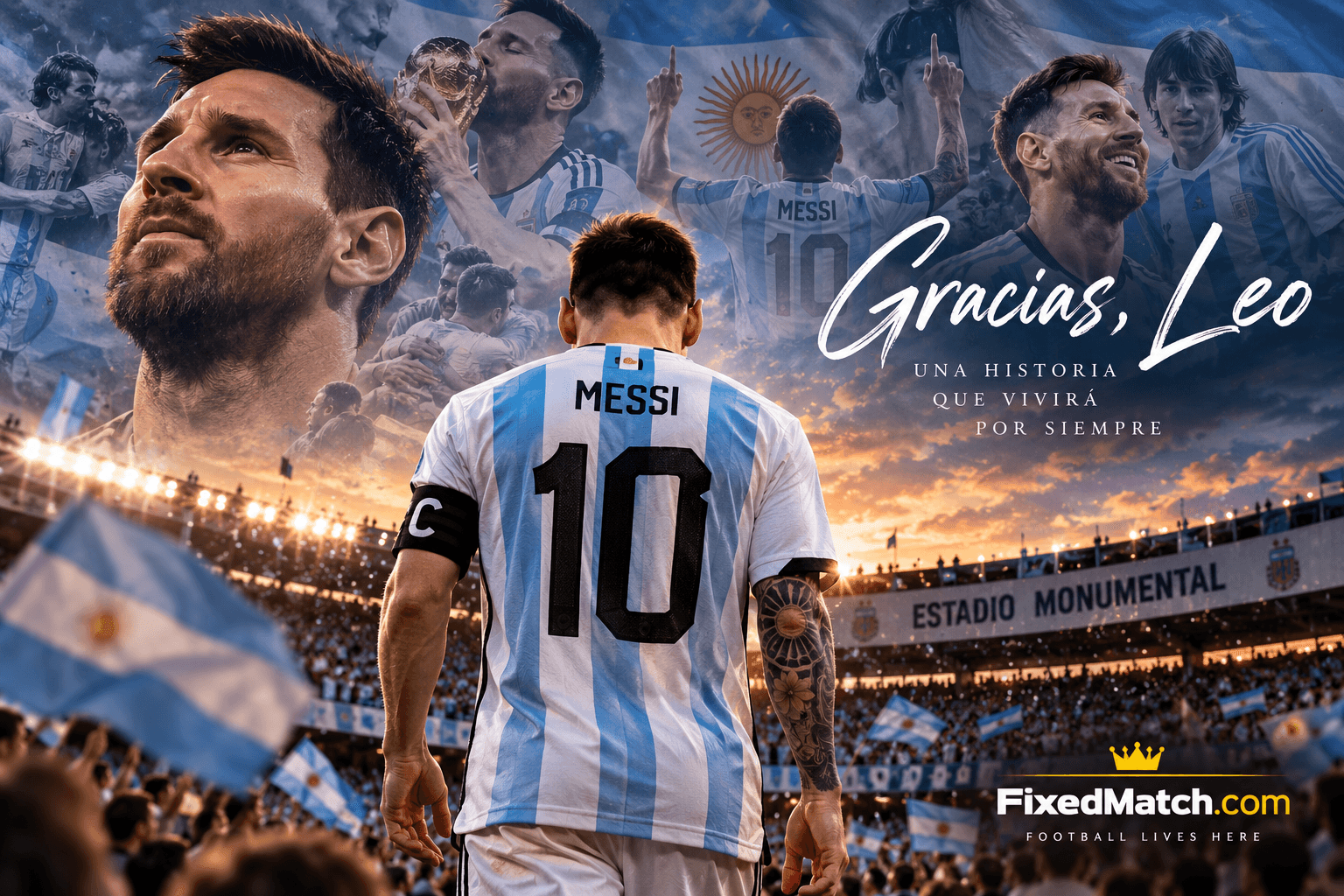
AFA has organised a “Gracias, Leo” Fan Fest on October 6 alongside the Argentina-Benin match, describing the day as a celebration of a story that has become part of Argentine football identity.
The Monumental is the perfect setting.
Messi has played there many times.
But this time will feel different.
Every touch will carry the awareness that it is one of the last.
Every corner.
Every free kick.
Every pass.
Every run.
Every time the stadium sings his name.
Everybody will know the clock is moving toward something they do not really want to arrive.
There Is Nothing Left to Prove
This is the most important point.
The Benin match is not one final test.
Messi does not need a goal to prove anything.
Argentina does not need to win 5-0.
He does not need another trophy.
He does not need another record.
His career does not require a perfect final scene.
The greatness has already happened.
This match is about appreciation.
It is about letting Argentina say thank you while he is still wearing the shirt.
If He Scores, the Monumental Might Shake
Of course, everybody will dream about the same ending.
Messi receives the ball.
The left foot opens.
The shot finds the corner.
The Monumental erupts.
It would be almost too perfect.
But football does not owe anyone perfect endings.
That uncertainty is part of the sport.
Even when analysing football predictions, fixed matches today or possible scorelines for Argentina against Benin, emotion cannot be mistaken for certainty.
Benin still have a match to play.
Argentina still have to earn whatever happens.
And perhaps that makes the occasion even more beautiful.
Nothing is scripted.
One Match Where Our Usual Analysis Feels Secondary
We analyse fixed matches, football fixed matches, form, odds, line-ups, correct score fixed matches, HT/FT markets and previous results.
We analyse fixed matches, form, odds, line-ups, correct score fixed matches, HT/FT markets and previous results.
Those things still exist for Argentina vs Benin.
There will be odds.
There will be predictions.
There will be possible scorelines.
But this match is bigger than those questions.
For once, the most important thing will not be whether Argentina win 2-0 or 3-1.
It will be watching the No. 10 one final time.
What Messi Gave Football Cannot Be Put Into a Spreadsheet
Football increasingly lives through numbers.
Goals.
Expected goals.
Assists.
Chances created.
Possession.
Passing accuracy.
Heat maps.
All useful.
None of them can measure the feeling of watching Messi at his best.
There is no statistic for the silence immediately before a defender realises Messi has changed direction.
There is no number for a stadium standing up because he has received the ball 40 metres from goal.
There is no metric that fully explains why millions of people stopped whatever they were doing because Messi had a free kick.
That is why football is more than data.
And Messi is one of the greatest examples of why.
A Generation Grew Up With Him
This farewell will feel personal to millions of people who have never met Messi.
That is what happens when a player stays at the highest level for so long.
Children watched him become the best player in the world.
Those children grew older.
Some became parents.
And Messi was still there.
Still playing.
Still creating moments.
Still wearing Argentina’s number 10.
For an entire generation, Messi did not feel like part of football history.
He simply felt like football’s present.
That is about to change.
Argentina After Messi
Argentina will continue.
It always does.
Lionel Scaloni has talented players and another generation ready to take greater responsibility.
But replacing Messi is not a football problem that can be solved by finding another No. 10.
There will not be another Messi.
The creative responsibility will be shared.
Leadership will evolve.
New stars will emerge.
Argentina may continue winning.
But the identity will inevitably change.
FIFA has described his farewell as occurring alongside the emergence of Argentina’s new generation, and AFA has already begun bringing younger faces into Scaloni’s squad.
That is how football works.
One era closes.
Another begins.
The No. 10 Will Still Exist, but It Will Feel Different
Someone else will eventually wear Argentina’s No. 10.
That player will not be replacing Messi.
He will simply be wearing the same number.
Because certain numbers stop being numbers after a while.
Brazil’s 10 carries Pelé.
Argentina’s 10 carries Maradona.
And now it carries Messi.
The shirt remains.
The association never completely leaves.
From Rosario to the Entire World
It is easy now to see Messi as an institution.
But every legend begins as a kid with a ball.
Rosario produced a boy with unusual talent.
Barcelona gave that talent a platform.
Argentina gave it a country to carry.
And football eventually gave Messi almost every possible stage.
He responded by producing one of the richest careers the sport has ever seen.
FIFA describes Messi as having won a record eight world-player awards and 40 club trophies, alongside his enormous international honours.
But again, the statistics are only the framework.
The memories are the story.
October 6 Is Not the End of Messi
It is the end of Messi playing for Argentina.
That distinction matters.
The goals will remain.
The videos will remain.
The shirts will remain.
Children who never saw him live will watch old clips years from now and wonder whether defenders really allowed him to do those things.
They did not.
They simply could not stop him often enough.
That is legacy.
Why He Is the Greatest of All Time
The case for Messi does not depend on one trophy.
It does not depend on one tournament.
It does not depend on one statistic.
It is the totality.
The scorer.
The creator.
The dribbler.
The passer.
The winner.
The longevity.
The consistency.
The reinvention.
The individual brilliance.
The team success.
The ability to dominate football in multiple roles for nearly two decades.
The ability to make the most difficult things in the sport appear effortless.
That is why, for this article, there is no debate section.
No qualification.
No “one of.”
Lionel Messi is the greatest footballer of all time.
Qatar did not make him that.
The World Cup simply gave the greatest player football had seen the image his career deserved.
One Last Time
On October 6, the Argentina players will walk toward the pitch at the Monumental.
Among them will be No. 10.
For the final time.
At some point, the ball will reach his left foot.
Maybe he will dribble.
Maybe he will create a goal.
Maybe he will score.
Maybe he will simply look around and take everything in.
And then eventually, the referee will blow the final whistle.
That moment may be the hardest part.
Because everybody watching will understand what it means.
More than twenty years of Argentina and Messi.
Finished.
Gracias, Leo
Football will continue.
It always does.
New stars will come.
Records will eventually fall.
New generations will argue about new players.
But some careers become reference points.
Before Messi.
After Messi.
That is the level he reached.
Argentina gave him a shirt.
He gave Argentina everything he had.
FIFA’s account of his retirement captured that clearly: Messi said he had always given everything for the shirt, through the victories and the years before them.
The relationship was complicated.
Then beautiful.
Then historic.
And now it reaches its final night.
There is nothing left to prove.
There is only one thing left to say.
Gracias, Leo.
Gracias for the goals.
Gracias for the passes.
Gracias for the dribbles.
Gracias for making impossible football feel ordinary.
Gracias for staying.
Gracias for coming back.
Gracias for the memories.
Gracias, GOAT.