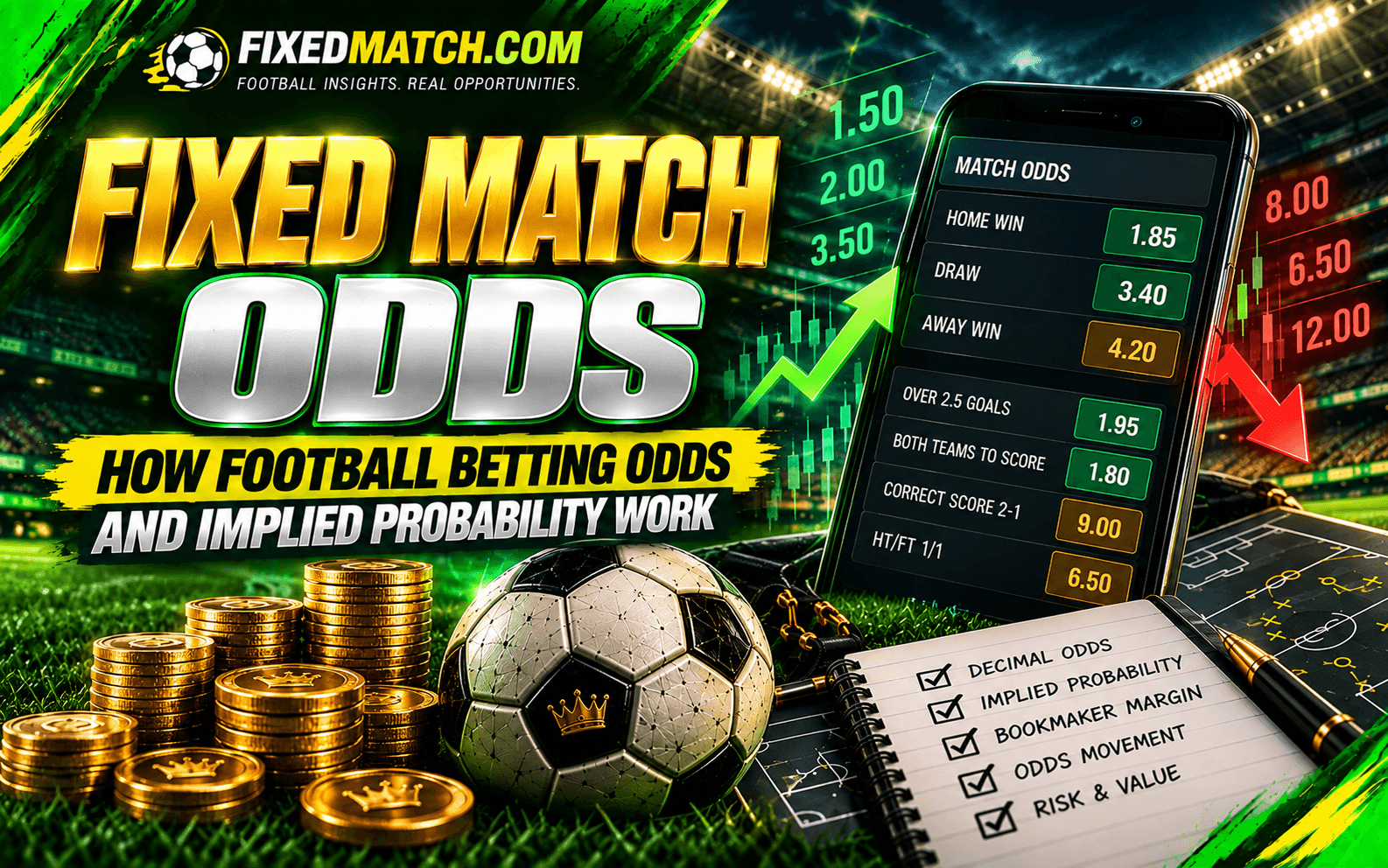
Fixed Match Odds: How Football Betting Odds and Implied Probability Work
James Wilson
Two football selections can look equally attractive until you compare the odds behind them.
One may offer 1.60.
Another may offer 8.00.
The larger number naturally attracts attention, but it also represents a very different level of uncertainty.
That is why understanding fixed match odds is useful when evaluating football information.
Odds are not proof that a prediction will win. They are prices that represent how the betting market values different possible outcomes.
This guide explains decimal odds, implied probability, bookmaker margins, odds movement and why a high potential payout should never be confused with higher reliability.
What Are Fixed Match Odds?
The phrase fixed match odds can refer to the betting prices attached to football selections promoted as fixed matches, premium predictions or high-confidence picks.
Those selections may involve markets such as:
- match winner
- correct score
- HT/FT
- both teams to score
- over/under goals
- accumulators
- combination tickets
The important point is that odds tell you about the price of an outcome.
They do not establish whether a match is genuinely manipulated or whether a prediction is correct.
Understanding what fixed matches mean helps separate football terminology from the way betting markets price outcomes.
How Decimal Odds Work
Decimal odds are commonly used across Europe and many international betting markets.
They show the total potential return for each unit staked.
For example:
| Odds | Stake | Potential return |
|---|---|---|
| 1.50 | €10 | €15 |
| 2.00 | €10 | €20 |
| 3.50 | €10 | €35 |
| 8.00 | €10 | €80 |
These examples are simplified and do not account for taxes, fees or other deductions that may apply.
The calculation is:
Potential return = Stake × Decimal odds
So a €20 selection at odds of 3.00 produces a potential total return of €60 if it wins.
Higher Odds Usually Mean More Uncertainty
This is one of the most important things to understand.
Higher odds may offer larger potential returns, but they normally reflect a lower estimated probability.
Consider these two fictional selections:
Selection A: Home win at 1.50
Selection B: Correct score 3-1 at 12.00
Selection B offers a much larger potential payout.
But predicting an exact score is far more restrictive than simply predicting the home team to win.
That is why high odds should not automatically be described as better.
They are simply different.
What Is Implied Probability?
Decimal odds can be converted into a basic implied probability.
The formula is:
Implied probability = 1 ÷ Decimal odds × 100
For example:
| Decimal odds | Raw implied probability |
|---|---|
| 1.50 | 66.7% |
| 2.00 | 50.0% |
| 2.50 | 40.0% |
| 4.00 | 25.0% |
| 5.00 | 20.0% |
| 10.00 | 10.0% |
So odds of 2.00 correspond to a raw implied probability of 50%.
Odds of 10.00 correspond to 10%.
This does not mean the true probability is exactly that number.
Bookmaker margins also affect the prices.
Why Bookmaker Probabilities Add Up to More Than 100%
Bookmakers build a margin into their markets.
Imagine a football match with these fictional prices:
Home win: 2.00
Draw: 3.40
Away win: 4.00
The raw implied probabilities are approximately:
Home: 50%
Draw: 29.4%
Away: 25%
Together, they total more than 100%.
That extra percentage represents the bookmaker margin built into the market.
This is one reason displayed odds should not be treated as perfect estimates of the real probability.
Why Odds Matter in Football Analysis
Odds provide another source of context.
Suppose your analysis strongly favours the home team.
If bookmakers also price that team as a heavy favourite, the market broadly agrees.
But suppose your analysis suggests a very close match while one team is priced extremely short.
That difference may encourage you to examine the fixture more carefully.
Strong football fixed matches analysis can use odds alongside team form, injuries, expected line-ups and tactical context.
Odds should complement analysis.
They should not replace it.
Odds Movement Can Be Interesting
Betting prices often change before kick-off.
For example:
A home team may open at 2.20.
Later, the price falls to 1.85.
That movement means the market price has changed.
There are many possible reasons:
- injury news
- confirmed line-ups
- high betting volume
- team announcements
- market corrections
- new public information
A price move does not automatically prove that someone has secret information.
It simply tells you that the market has changed.
Team News Can Move Odds
Late injury information can influence prices quickly.
Suppose a team’s main striker is unexpectedly ruled out.
The market may become less confident in that team.
Its odds could increase.
Meanwhile, the opposing team’s price could shorten.
This is one reason fixed matches today should be evaluated using current information.
A prediction created several days earlier may need to be reconsidered if the football circumstances change.
Confirmed Line-Ups Can Change the Market
Official line-ups are often released shortly before kick-off.
That creates another important information point.
If a manager rests several important players, the market may react.
If a star player unexpectedly starts after being considered doubtful, prices can move in the opposite direction.
Line-ups therefore matter not only for tactical analysis but also for understanding late odds movement.
Correct Score Odds Are Usually Higher
Correct score fixed matches require the exact final result.
That naturally creates more possible outcomes.
A home-win market might succeed with:
1-0
2-0
2-1
3-0
3-1
and many other home-winning scores.
A correct-score selection of 2-1 succeeds only if the match finishes exactly 2-1.
That difference explains why exact-score odds are usually much larger than simple match-winner prices.
Higher odds reflect the additional precision required.
HT/FT Odds Also Include Two Conditions
The same idea applies to HT/FT fixed matches.
An X/1 selection requires:
the match to be level at half-time,
and the home team to win at full-time.
Both conditions must happen.
That is more restrictive than simply backing the home team to win.
As a result, HT/FT prices can be higher than standard 1X2 odds.
Again, the higher return comes with additional conditions.
Low Odds Do Not Mean Guaranteed
Very short odds can create a false sense of certainty.
Imagine a strong favourite priced at 1.20.
That price indicates the market expects the team to be highly likely to win.
But highly likely is not the same as guaranteed.
Football still contains uncertainty.
A red card can change the match.
A penalty can be missed.
A goalkeeper can make an error.
An underdog can outperform expectations.
Low odds reduce the potential return partly because the outcome is considered more likely.
They do not eliminate risk.
Why Accumulator Odds Grow Quickly
Accumulators combine several selections.
Suppose three fictional picks are priced at:
1.50
1.80
2.00
Combined decimal odds are calculated approximately by multiplying them:
1.50 × 1.80 × 2.00 = 5.40
That larger price can look attractive.
But every selection must succeed.
If two win and one loses, the accumulator loses.
Adding more selections increases the number of conditions that must be correct.
Comparing Odds Between Sources
Prices can differ between bookmakers.
One may offer 2.10.
Another may offer 2.25 for the same outcome.
That difference can affect potential returns over time.
However, comparing prices should not replace evaluating the underlying football selection.
A slightly better price on a weak prediction does not suddenly make the prediction strong.
The quality of the analysis comes first.
The price comes afterward.
Odds and Previous Results
Historical records become more informative when odds are included.
Suppose two services each show ten winning predictions.
Without prices, those records tell only part of the story.
One service may have been selecting favourites around 1.20.
Another may have been selecting outcomes around 2.50.
Reviewing previous offers and completed results alongside the advertised odds gives more context about historical selections.
Win rate and odds should be understood together.
Win Rate Without Odds Can Be Misleading
Consider two fictional services:
| Service | Wins | Losses | Average odds |
|---|---|---|---|
| A | 8 | 2 | 1.20 |
| B | 5 | 5 | 2.60 |
Service A has a much higher win rate.
But that alone does not establish which historical record produced better financial performance.
Stake sizes and prices matter.
That is why fixed matches results should not be evaluated through win percentage alone.
Odds Do Not Verify Genuine Information
A high or low price cannot prove that information is genuine.
If someone claims a match is certain because the odds are 20.00, the size of the price does not support that conclusion.
Likewise, rapidly falling odds do not automatically prove match manipulation.
People researching genuine fixed matches should look at publication history, transparency, previous information and current match context rather than treating odds as proof.
Premium Pricing and Betting Odds Are Different Things
Another common confusion is mixing the price of the service with the odds of the football selection.
They are completely different.
A premium fixed matches package may cost more because of:
- private access
- additional research
- faster delivery
- specialised markets
- customer support
That does not mean the selections themselves must have higher betting odds.
Service price and betting price should be evaluated independently.
The Biggest Odds Are Not Always the Best Selection
Some bettors naturally search for the highest possible return.
But the largest number should not automatically determine the choice.
A 25.00 selection may produce an impressive payout if successful.
It also represents considerably more uncertainty than a 1.80 selection.
The best fixed matches should therefore be evaluated using evidence and context rather than simply choosing the highest odds available.
Odds Should Match the Market Being Predicted
Different markets naturally have different price ranges.
Match winner selections may have relatively modest odds.
Correct score markets may be significantly higher.
HT/FT prices can sit somewhere in between depending on the combination.
Accumulator prices can grow very quickly.
Comparing a 1.80 match-winner price with a 12.00 correct-score price without considering the market conditions makes little sense.
The type of prediction matters.
Responsible Betting and Odds
Large potential payouts can encourage larger or more impulsive bets.
That makes responsible decision-making particularly important.
Do not increase a stake simply because the odds are high.
Do not chase previous losses with a larger accumulator.
Do not assume short odds make a selection safe.
Betting always involves financial risk.
Fixed Match Odds Checklist
Before judging a football selection by its odds, ask:
| Question | Why it matters |
|---|---|
| What market is being predicted? | Different markets have different probabilities |
| What are the decimal odds? | Shows potential return |
| What is the implied probability? | Helps interpret the price |
| Has the price moved? | May indicate new market information |
| Has team news changed? | Can explain odds movement |
| Are line-ups confirmed? | May alter expectations |
| What odds were originally advertised? | Useful for historical verification |
| Is the price being used as proof? | Odds do not verify a prediction |
How FixedMatch.com Organizes Football Information
FixedMatch.com combines current fixed matches information with historical records and educational articles covering different football markets.
Visitors can examine selections, previous results and supporting analysis rather than interpreting odds in isolation.
Articles covering HT/FT, correct score, daily information and football analysis provide additional context for understanding why different markets carry different prices.
Final Thoughts
Fixed match odds are prices, not guarantees.
They help describe the market’s view of an outcome and determine potential returns.
Higher odds generally represent greater uncertainty.
Lower odds generally reflect a stronger market expectation.
But neither proves what will happen in the match.
Team news, line-ups, form, tactics and the type of betting market all remain important.
The best way to interpret football odds is therefore not to ask:
“Which number pays the most?”
A better question is:
“What does this price tell me about the outcome I am being asked to predict?”